PROMOTE TRANSPARENCY AND ACCESS

-
Government policymakers and regulators face growing pressure to protect consumers, strengthen the economy, and modernize oversight. Industry members, meanwhile, carry the day-to-day burden of implementation as they translate regulatory requirements into operational reality while managing cost, complexity, and change. GS1 US helps align these needs by providing a neutral, industry-governed system of globally recognized standards that supports transparency, interoperability, and trust across public and private ecosystems.
-
Related Articles
How GS1 US Supports Public Policy
GS1 US helps policymakers and regulators advance practical, effective policies by providing globally recognized standards and a neutral forum for industry collaboration. Through a common language for identifying products and exchanging information, GS1 Standards help align policy goals with the realities of implementation, supporting compliance and enabling more consistent oversight, which creates shared value for government, industry, and consumers.
Because GS1 Standards are already used across industries and supply chains, policymakers can build on an established foundation that businesses already understand and trust. That foundation can help advance policy objectives while supporting adoption without requiring entirely new or duplicative systems and processes.

Standards for Smart Policy
Standards bring consistency and clarity to complex regulatory environments and help bridge the gap between policy intent and daily operational realities. Decades of industry adoption give policymakers a proven foundation to build smarter regulations grounded in systems that already work.
FSMA Rule 204: Food Traceability
The Food Safety Modernization Act (FSMA) aims to strengthen food safety by focusing on prevention and improving traceability across the food supply chain. GS1 Standards provide a globally recognized framework for product identification and data sharing that is already used across the food industry to support traceability and information exchange. Traceability enabled by GS1 Standards supports faster response to food safety events, improved supply chain visibility, enhanced consumer protection, and greater confidence in the safety of the food supply.

Drug Supply Chain Security Act (DSCSA)
The Drug Supply Chain Security Act (DSCSA) requires package-level serialization using a 2D barcode that encodes standardized product data. Industry has aligned on GS1 DataMatrix, using GS1 identifiers and application standards to enable consistent, interoperable traceability across the pharmaceutical supply chain. Standardized identification and traceability support patient safety by helping supply chain partners identify and verify products, reducing the risk of patients receiving incorrect, harmful, or counterfeit drugs.

Unique Device Identification (UDI)
The U.S. FDA's Unique Device Identification (UDI) system establishes a standardized approach for identifying and tracking medical devices throughout the healthcare ecosystem. FDA-recognized GS1 Standards support UDI by enabling standardized device identification, barcoding, and data sharing among trading partners. Using GS1 Global Trade Item Numbers (GTINs) and barcode standards can help organizations identify and trace medical devices more accurately, which supports patient safety, supply chain visibility, and the processes organizations use to manage regulatory requirements.

National Drug Code (NDC) and 2D Barcodes
On March 5, 2026, FDA finalized a rule replacing today’s variable 10-digit NDC with a standardized 12-digit format used across prescription drugs, over-the-counter medicines, and animal health products. FDA-recognized GS1 Standards, including GS1 DataMatrix and other 2D barcodes, support the transition by enabling consistent product identification, data sharing, and barcode implementation across the healthcare supply chain. By encoding more information in less space than traditional linear barcodes, 2D barcodes can help organizations adapt to new data requirements while supporting efficient, interoperable data exchange among healthcare trading partners.

Supplemental Nutrition Assistance Program (SNAP)
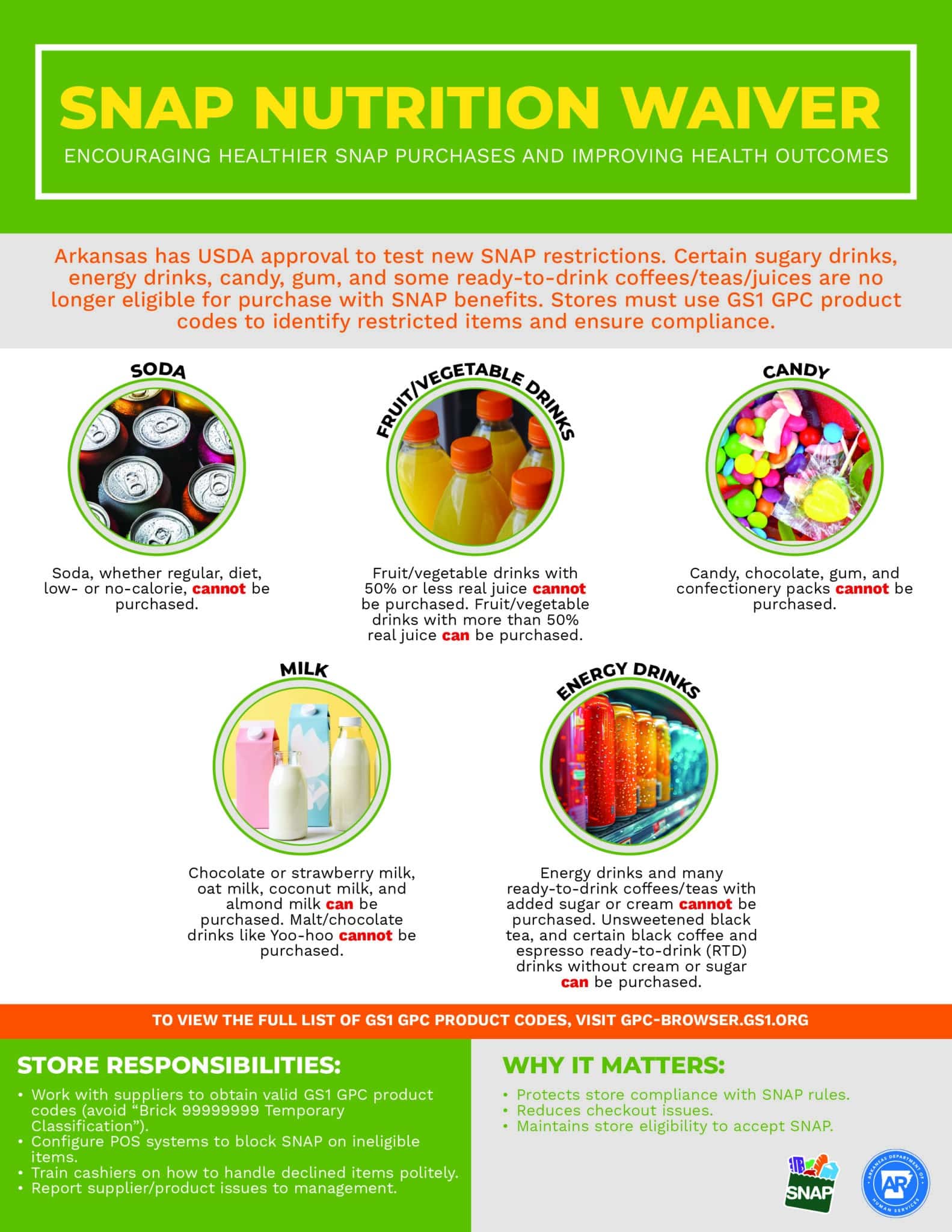
A number of states have received USDA approval to restrict certain products from SNAP purchases. To support implementation, states including Texas and Arkansas have referenced GS1’s Global Product Classification (GPC) standard as a way to help identify products that may be eligible or ineligible under SNAP requirements. A common product classification framework such as GPC can support more consistent implementation and help brands, manufacturers, and retailers align product data with evolving program requirements.

Cash Visibility
The U.S. cash supply chain continues to rely on manual, paper-based processes that can limit visibility, efficiency, and traceability as cash moves between financial institutions, cash handlers, and retailers. The Federal Reserve's move from paper to e-manifests through its FedCash® E-Manifest Service, which leverages GS1 Standards, signals a broader shift toward digital information exchange across the cash ecosystem. GS1 Standards for Cash Visibility provide a common, interoperable framework for identifying locations, tracking cash assets, and sharing standardized information, which can help financial institutions, armored carriers, and other cash supply chain partners improve efficiency, resilience, and traceability across the cash supply chain.

Extended Producer Responsibility (EPR)
Extended Producer Responsibility (EPR) laws are emerging in a growing number of states as policymakers look to address packaging waste and advance sustainability goals through producer reporting and accountability requirements. To help organizations navigate these evolving requirements, GS1 US convened a cross-industry workgroup and published guidance on using GS1 Standards, including Global Trade Item Numbers (GTINs), Global Location Numbers (GLNs), and a standardized data model to support packaging data collection and reporting. Standardized packaging data can help organizations manage increasingly complex state requirements, improve data consistency across trading partners, and support regulatory reporting efforts more efficiently.

Customs and Border Protection’s Global Business Identifier (GBI) Test
U.S. Customs and Border Protection (CBP) is exploring the use of a Global Business Identifier (GBI) to create a more consistent approach to identifying businesses across international trade processes. As part of its GBI testing efforts, CBP evaluated the use of GS1 Global Location Numbers (GLNs) as a potential business identifier and publicly references GS1 US among the organizations participating in the initiative. Standardized business identification can help improve data consistency and interoperability across government agencies and trading partners, supporting more efficient information exchange throughout the global supply chain.

Connect with the USDA Branded Foods Database
The USDA Global Branded Food Products Database (GBFPD) enhances public access to nutrient and ingredient information for branded and private label foods, using information provided by the food industry. The database is the result of a public-private partnership that includes: the U.S. Department of Agriculture, Agricultural Research Service (USDA ARS); GS1 US®; the Institute for the Advancement of Food and Nutrition Sciences (IAFNS); 1WorldSync, by Syndigo; the University of Maryland; and Euromonitor International. Brand owners can share their product data with the USDA GBFPD through the GS1 Global Data Synchronization Network™ (GS1 GDSN®), providing an opportunity to contribute to a nationally trusted resource while ensuring data remains current, consistent, and aligned with product labels.


Electronic Product Information Leaflets (ePILs) are being adopted in a growing number of countries as a digital alternative to the traditional paper package leaflet found in medicine boxes. GS1 Digital Link supports ePIL by connecting products through a QR code to this information from the manufacturer that can be updated in real time. Pharmacists and other healthcare professionals, as well as patients, can access up-to-date information such as dosage instructions, side effects, and safety warnings, directly from their smart devices.
Using Radio Frequency Identification (RFID) to Combat Retail and Cargo Theft

The proposed Combating Organized Retail Crime Act (CORCA) would establish a coordinated federal approach to combating organized retail crime and cargo theft. GS1 Standards, including RFID and standardized product identification already used across retail supply chains, can support item-level traceability from source to sale. Greater visibility into product movement can help retailers and law enforcement investigate stolen goods and strengthen supply chain security while improving inventory accuracy and supporting product availability for consumers.
Additional Insights
Government agencies, public health organizations, and industry stakeholders are navigating rapid changes in how information is captured, shared, and used across complex supply chains. Traceability, digital product information, and data sharing are becoming increasingly important to support decision-making and policy objectives.
The GS1 system of standards contributes to government and public health initiatives by providing a common framework for identifying products, sharing information, and supporting traceability across complex supply chains. Standards such as Global Trade Item Numbers (GTINs), the Global Data Synchronization Network (GDSN), and Electronic Product Code Information Services (EPCIS) help stakeholders share product and traceability information more consistently across public and private sector ecosystems. This helps government and industry work from the same reliable information, supporting more informed decision-making across public health, food safety, healthcare, and regulatory initiatives.
The most significant emerging trends in digital supply chain transformation for government operations center on trusted data, end-to-end visibility, traceability, and interoperability across agencies, suppliers, healthcare providers, and logistics partners. Increasingly, governments are looking to build initiatives on globally recognized standards and shared data frameworks that support more consistent information sharing and collaboration across public and private sector stakeholders.
In practice, these trends are driving greater traceability across food, healthcare, and retail supply chains. They expand access to digital product information and increase the use of standardized data to support oversight and compliance. Examples include food traceability requirements under FSMA, pharmaceutical traceability and serialization under DSCSA, the adoption of 2D barcodes and digital product information in healthcare, and efforts to modernize the U.S. cash supply chain through standardized data exchange.
Public health organizations and government hospitals should begin preparing for the industry-wide transition to 2D barcodes now, as healthcare initiatives are increasingly relying on richer product data, improved traceability, and greater interoperability across supply chains.
To help them get started, organizations should assess their current scanning infrastructure and determine whether their systems can read and process GS1 DataMatrix data. Any gaps identified during that assessment can help inform upgrade and implementation plans.
Running pilot programs can help organizations evaluate 2D barcode scanning in pharmacy, inventory, receiving, medical device tracking, and point-of-care workflows. They should also work with suppliers and distributors to align on adoption plans and identify any barriers to implementation. Organizations should prepare for related healthcare initiatives, including evolving National Drug Code (NDC) requirements, which are expected to increase reliance on 2D barcodes.
During the transition, hospitals should support both 1D and 2D barcodes and provide staff training on how 2D barcodes can improve traceability, recall readiness, inventory visibility, and patient safety.
Connect With Our Government & Regulatory Team
Share Your Interest in Contributing to Policy Discussions